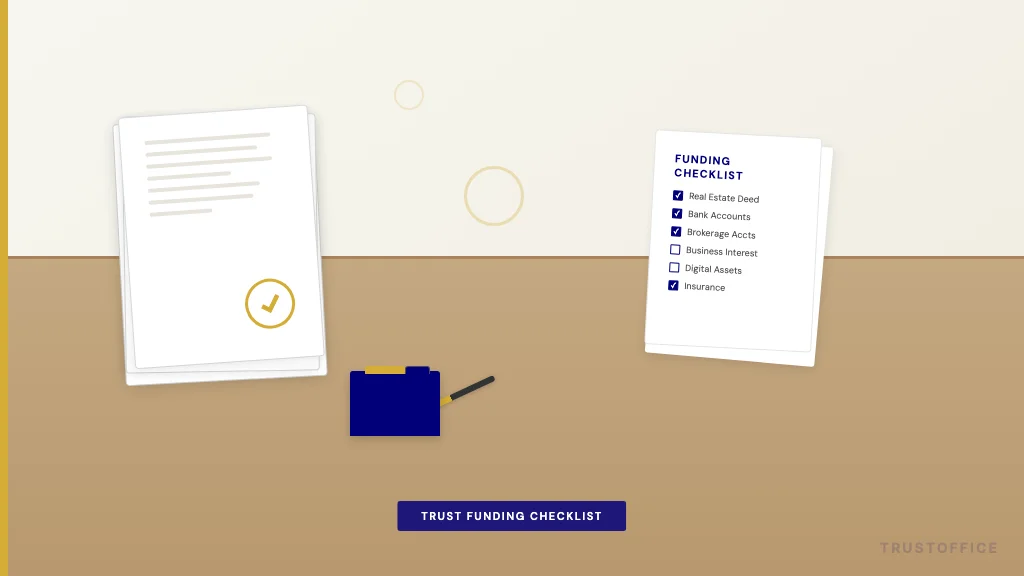
You spent thousands on attorneys’ fees drafting a trust. The documents are signed, notarized, and filed safely away. Your estate plan is complete.
Except it is not.
The single most common mistake in trust planning — one that estate planners estimate affects 60 to 70 percent of trusts — is failing to fund the trust. The trust document exists, but the assets never left the grantor’s individual name. When death or incapacity strikes, the trust is a hollow shell. The assets go through probate anyway, which is exactly what the trust was supposed to prevent.
This article covers what trust funding actually means, which assets need to move, how to move them, and the documentation trail that keeps trustees out of trouble.
What “Funding a Trust” Actually Means
Funding a trust means changing the legal title of assets from your individual name to the name of the trust. A trust is a legal entity — like a person — that can own property. But unlike a person, it only owns what is formally transferred to it.
A trust with no assets is an empty box. The grantor may feel protected, but a beneficiary or creditor who looks inside finds nothing. The pour-over will — a backup document that “pours” assets into the trust at death — only works after probate. It does not avoid probate. It just redirects the probate outcome.
The rule is simple: if an asset does not have the trust’s name on the title, the trust does not control it.
The Assets That Must Be Funded
Every type of asset follows a different transfer process. Here is the breakdown by category.
Real Estate
Real estate is the biggest funding failure point. A deed signed after the trust is created must be recorded with the county recorder’s office showing the transfer from the individual to the trustee of the trust.
- Primary residence and vacation homes need a new deed: “John Smith, Trustee of the John Smith Revocable Living Trust dated July 1, 2026.”
- Rental properties follow the same process.
- Out-of-state property may require a separate deed in the state where the property sits.
- Transfer on death deeds in states that allow them (California, Texas, Ohio, and others) can work as a backup but are not a replacement for full funding.
A common trap: refinancing a mortgage. When you refinance, the lender may require the property to be taken out of the trust and put back in your individual name. Many people refinance and never put the property back into the trust. The trust is unfunded again, and nobody notices until it is too late.
Bank Accounts
Bank accounts must be retitled or re-registered. This is not complex, but it is tedious.
- Open a new account in the trust’s name, or
- Change the existing account’s registration to the trust.
Most banks have a simple form for this. However, some bank tellers do not understand what a trust is and will push back. If you encounter resistance, ask for the branch manager or the bank’s trust department.
Do not rely on payable-on-death (POD) designations. A POD beneficiary designation avoids probate, but it does not put the account under the trust’s control during incapacity. If the grantor becomes incapacitated and the account is only POD, a successor trustee has no authority to access the funds for the grantor’s benefit.
Investment and Brokerage Accounts
Brokerage accounts (Schwab, Fidelity, Vanguard, and similar firms) typically cannot simply be retitled. Instead, you must transfer the assets to a new trust account.
- The process: open a new account registered to the trust, then transfer the securities “in kind” — meaning the investments move without selling them.
- Most major brokerages have an estate-planning desk that handles this regularly.
- Retirement accounts (IRAs, 401(k)s, 403(b)s) generally cannot be transferred into a revocable living trust while the grantor is alive. This is a critical exception. Instead, name the trust as the beneficiary of the retirement account. This ensures the trust controls distribution after death while preserving the tax advantages of the retirement account during the grantor’s life.
A 2025 Charles Schwab survey found that 47 percent of trust owners had not transferred their investment accounts into the trust. That is nearly half.
Business Interests
If the grantor owns a business — an LLC, corporation, or partnership — the ownership interest must be transferred to the trust.
- LLC membership interests: amend the operating agreement to reflect the trust as the member, or assign the membership interest to the trust.
- Corporate stock: reissue the stock certificate in the trust’s name.
- Sole proprietorships: this is more complicated and may require forming an LLC first.
Business owners often skip this step because it feels like “messing with the business.” But an unfunded business interest in a trust context means the business goes through probate, potentially freezing operations for months.
Personal Property
Cars, boats, RVs, and aircraft are titled property. Each has its own registration process through the motor vehicle department.
- Vehicles: some states allow retitling, while others do not. In many states, the vehicle registration is hard to change into a trust name. A pour-over will often handles vehicles more practically than attempting to retitle them individually.
- Jewelry, art, collectibles: these are generally not retitled. Instead, a bill of sale or assignment document listing them as trust property should be signed by the grantor and kept with the trust records.
Digital Assets
This is the newest category and the one most trustees ignore. Cryptocurrency, domain names, digital business accounts, social media accounts, and online storage all fall under the Revised Uniform Fiduciary Access to Digital Assets Act (RUFADAA), which has been adopted in most states.
- Cryptocurrency held on an exchange: the exchange account should be registered to the trust, or the trust should be named as the beneficiary.
- Cryptocurrency in a self-custody wallet: the private keys must be documented and accessible to the successor trustee. This is where many estate plans fail — the keys are lost.
- Domain names and websites: transfer registrar ownership to the trust.
- Cloud storage and subscription accounts: document access credentials in a secure location accessible to the trustee.
The American Bar Association’s January 2026 issue on digital assets and estate planning highlights this gap as an emerging liability risk for trustees who fail to account for digital property in trust administration.
The Pour-Over Will: Safety Net, Not Solution
A pour-over will directs that any assets not held by the trust at the time of death be transferred into it. This sounds like a fix, but it is not.
A pour-over will must go through probate. The entire point of a trust is to avoid probate. If the pour-over will catches significant assets, those assets will be stuck in probate for months — which is what the trust was designed to prevent. The pour-over will catches the forgotten bank account with $500 in it. It does not save the $500,000 house that was never deeded.
The Trust Funding Checklist
Here is the practical checklist every trustee and estate planner should use.
Real Estate
- Deed recorded for each property
- Mortgage lender notified (if required)
- Property insurance updated to trust as owner
- Tax assessor notified (in some states)
Bank Accounts
- Checking accounts retitled
- Savings accounts retitled
- Money market accounts retitled
- CDs retitled
- Safety deposit box re-registered
Investments
- Brokerage accounts transferred to trust account
- Retirement accounts beneficiary designation updated to trust
- Annuities beneficiary updated
- Stock certificates reissued
Business Interests
- LLC membership transferred
- Corporate shares reissued
- Operating agreement amended
- Business bank accounts retitled
Insurance
- Life insurance beneficiary changed to trust
- Disability insurance beneficiary updated
Digital Assets
- Crypto exchange accounts registered to trust
- Self-custody wallet keys documented
- Domain name registrations transferred
- Social media account access documented
- Digital storage account access documented
Personal Property
- Vehicle titles (if required in your state)
- Boat/aircraft registration
- Assignment document for valuables
- Safe deposit box contents documented
The Documentation Problem
Here is where most trustees fall short: they fund the trust but do not document the process.
When a successor trustee takes over — because the grantor has died or become incapacitated — they need to know what assets belong to the trust and where those assets are held. A trust funding checklist signed by the grantor, with account numbers, property addresses, and contact information, turns a months-long treasure hunt into a morning’s work.
Without this documentation, successor trustees face a nightmare: searching through files, guessing at accounts, contacting banks cold, and running into dead ends. Every missed asset is a potential surcharge claim.
This is where governance software such as TrustOffice changes the equation. Instead of a paper checklist that gets lost or outdated, digital trust governance provides a living record of trust assets, their titles, and their documentation status. Beneficiaries can be given read-only access to verify what exists. Successor trustees inherit a complete asset map on day one.
What Happens When a Trust Is Not Funded
The consequences are straightforward and severe.
- Probate. The unfunded assets go through probate court. In California, probate takes an average of 9 to 12 months and costs 4 to 7 percent of the estate’s value in fees.
- No incapacity protection. A successor trustee cannot manage assets that are not in the trust. If the grantor becomes incapacitated, the family may need a conservatorship — a court process that is more expensive and public than probate.
- Beneficiary disputes. When assets show up outside the trust, beneficiaries question whether the trust was properly administered. Contested trusts lead to litigation, which drains the estate and fractures families.
- Personal liability for the trustee. A trustee who fails to fund the trust — or who fails to confirm funding was completed — can be surcharged for losses. Courts have held trustees personally liable for assets that should have been in the trust but were not.
Three Actions to Take This Week
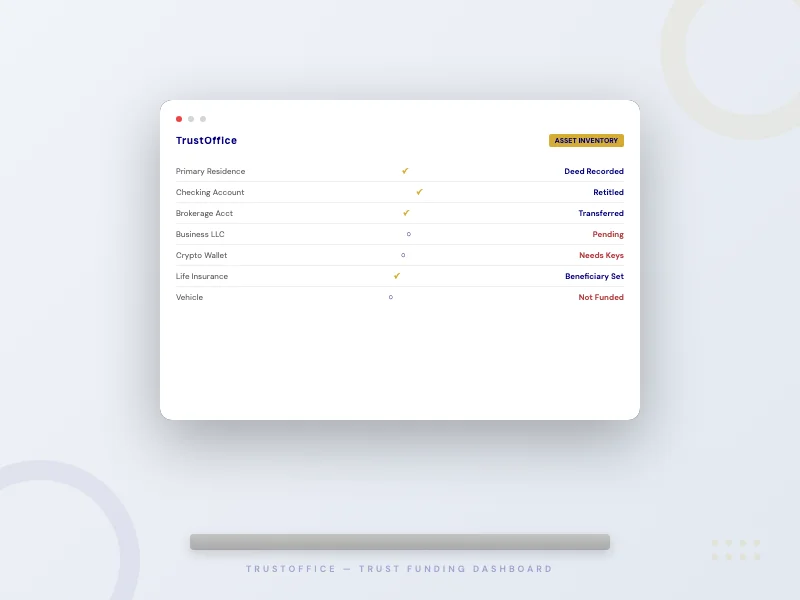
One: Verify. If you are a trustee or a grantor, verify every asset against the checklist above. Most people discover at least one major asset that was never transferred.
Two: Document. Create a trust asset inventory — a single document listing every asset, the title status, the account number, and the contact for the institution holding it. Store it with the trust documents.
Three: Govern. Use trust governance software to maintain the asset inventory as a living document. TrustOffice provides a dashboard where trustees document asset titling, track funding status, and give beneficiaries visibility into what exists — without giving them operational control.
FAQ
What percentage of trusts are not fully funded?
Estate planning attorneys estimate that 60 to 70 percent of trusts are never fully funded. A 2025 Schwab survey found that 47 percent of trust owners had not transferred investment accounts into the trust.
Can a pour-over will fix an unfunded trust?
No. A pour-over will forces the assets through probate before they reach the trust. It avoids intestacy (dying without a will), but it does not avoid probate. The trust’s main benefit is lost.
Do retirement accounts go into a trust?
Generally no. IRAs, 401(k)s, and similar retirement accounts cannot be transferred into a revocable living trust while the grantor is alive. Instead, name the trust as the beneficiary of the retirement account. This preserves tax advantages while ensuring trust control after death.
What happens if a successor trustee finds unfunded assets?
The successor trustee must initiate probate for those assets, which delays distribution and adds cost. The trustee should also document the finding and notify beneficiaries to avoid surcharge claims.
Does a trust protect assets from creditors if it is not funded?
No. An unfunded trust protects nothing. The assets remain in the grantor’s individual name and are fully exposed to creditors, judgments, and lawsuits.
How long does it take to fund a trust?
Most trusts can be fully funded within two to four weeks if the grantor is organized. Real estate deeds require county recording (5 to 30 days depending on the county). Brokerage account transfers take 3 to 10 business days.
Should I re-title my car into the trust?
It depends on your state. Some states (Florida, New York) require re-titling for the trust to control the vehicle. Other states make it impractical or expensive. Ask your estate planning attorney what your state recommends.
Does TrustOffice track trust funding status?
Yes. TrustOffice provides an asset inventory dashboard where trustees document each asset, its titling status, and the documentation trail — all accessible to successor trustees and verifiable by beneficiaries.